Buying land in Frio County can feel simple at first glance. A tract may have a creek nearby, a visible road, and plenty of open ground, but water, access, and day-to-day usability often decide whether a property truly fits your plans. If you are weighing a ranch, ranchette, or acreage tract in this part of South Texas, it helps to know what to verify before you move forward. Let’s dive in.
Why usability matters in Frio County
Frio County sits in the Winter Garden Region of Southwest Texas within the Nueces River basin, with the Frio and Leona rivers and San Miguel Creek shaping local drainage. Because the terrain is generally flat to slightly rolling, a property’s floodplain position, drainage pattern, and road elevation can matter just as much as total acreage.
That means two tracts with similar size and price can function very differently. One may offer easier access, better building areas, and more practical water options, while another may come with added limitations that only show up during due diligence.
Water starts with location
Water in Frio County is not just about whether you see a tank, creek, or river on the map. It is also about how surface water and groundwater interact across the landscape, especially in areas tied to recharge zones.
A Frio River watershed report notes that the watershed crosses multiple aquifer recharge zones, including Edwards, Carrizo-Wilcox, Queen City-Bigford, and Sparta-Laredo. For you as a buyer, that is an important reminder that a tract near a creek or river may raise different questions about well potential, drainage, and long-term use than a parcel farther away.
Groundwater is regulated locally
In Texas, groundwater is regulated by local or regional groundwater conservation districts rather than one statewide agency. In Frio County, that role belongs to the Evergreen Underground Water Conservation District, which oversees well registration, permitting, spacing, and monitoring.
EUWCD identifies the Carrizo-Wilcox as a major aquifer in Frio County, with the Queen City and Sparta listed as minor aquifers. That local framework matters because a well is not just a physical improvement. It is also a regulated feature that should be reviewed carefully during a purchase.
Not every well is treated the same
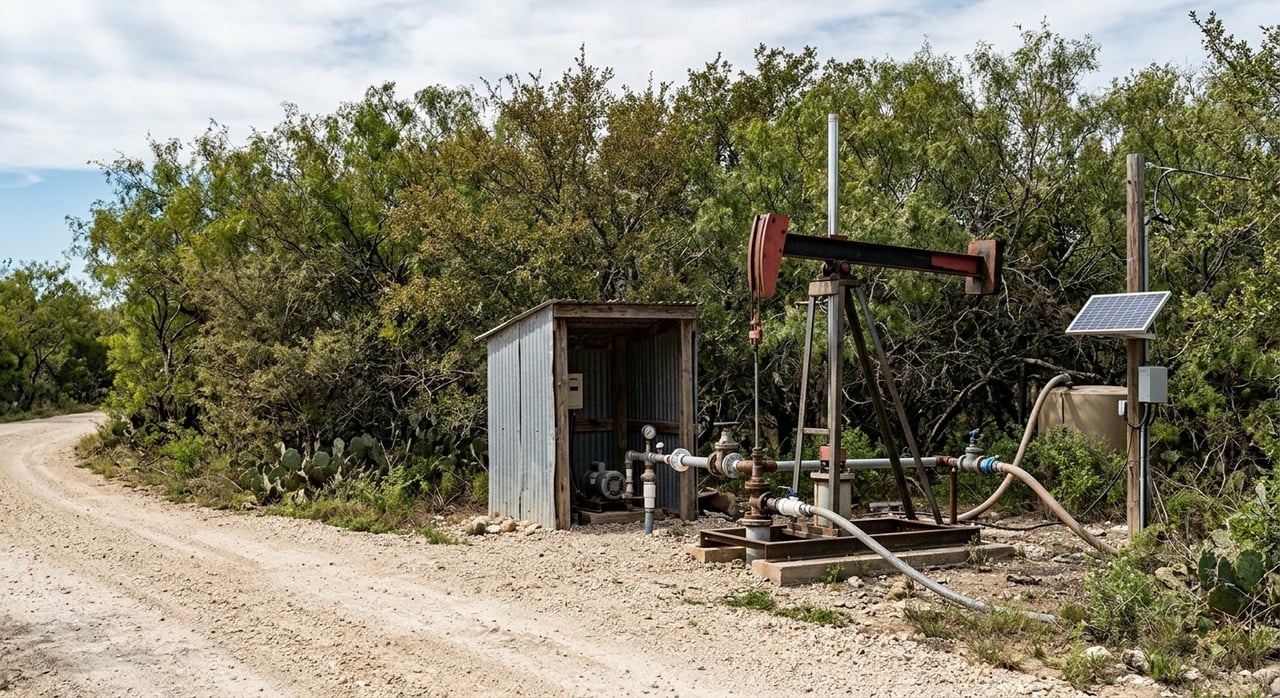
According to EUWCD, wells capable of more than 25,000 gallons per day or 17.5 gallons per minute, or wells used for public supply, irrigation, commercial, or industrial purposes, require a production permit. Smaller domestic or livestock wells are generally exempt from permitting, but they still must be registered.
The district also states that new wells must be reviewed before drilling and that ownership of existing wells should be registered or transferred within 45 days of sale. If a seller says a well is already in place, that should lead to a simple next question: is the paperwork current and on file?
Well quality matters as much as well presence
A well on the property can be a big plus, but the existence of a well does not answer every practical question. You still need to know its condition, production history, and water quality.
Texas A&M AgriLife guidance for private wells says well owners are responsible for managing their own drinking water, maintaining records, and testing at least once a year. It recommends annual testing for nitrate, total dissolved solids, and E. coli or fecal coliform.
That same guidance also points owners to historical well information through TWDB groundwater records and TCEQ well reports. In practical terms, if you are evaluating a Frio County tract with an existing well, it is smart to request:
- The well log or driller report
- EUWCD registration or permit documents
- Recent water-quality test results
- Any available service or pump records
AgriLife also notes setback distances from septic tanks, drainfields, feed storage, and manure areas. That matters because usability is not just about where the water comes from. It is also about whether the site layout supports safe, workable use over time.
River or creek frontage does not equal water rights
This is one of the most important points for land buyers in Texas. If a Frio County tract touches a river or creek, that does not automatically mean you can freely divert, store, or use that water however you want.
The Texas Commission on Environmental Quality states that surface water is owned by the state and held in trust for the public. In general, anyone who wants to use surface water needs state permission unless a specific exemption applies.
Understand the Nueces basin framework
Frio County is listed in the Nueces basin portion of the South Texas Watermaster area. TCEQ says this program administers water rights, tracks authorized use, monitors streamflow and reservoir levels, and enforces compliance.
For you, the takeaway is simple: water frontage may add appeal, but it should not be treated as a guaranteed usable water source without documentation. If a tract’s value or intended use depends on pumping from a creek or river, you want written proof of the right or a clear explanation of any claimed exemption.
Exemptions still need verification
TCEQ notes that some domestic and livestock uses can be exempt from surface-water permitting requirements. But the exemption depends on the exact use and the applicable water code rules.
That means you should verify, not assume. A seller’s informal statement is not the same as having the supporting records in hand.
Access can make or break a land purchase
A good-looking tract loses a lot of value if you cannot legally or practically get to it. In Texas, access is one of the first things worth confirming, especially on rural acreage.
Texas A&M AgriLife explains that there is no automatic right to access landlocked property in Texas. The clearest solution is usually a written express easement that is signed and filed in county deed records.
If legal access is unclear, marketability and financing can suffer. That is why access should be documented early, not treated as something to sort out after closing.
Private road versus public road
Not every visible road is a public road. Some ranch roads and internal drives work fine for actual use, but they may still be private roads from a legal or maintenance standpoint.
TxDOT county-road criteria say a road must be open to the public 24 hours a day, 7 days a week to qualify for the county road inventory, with limited exceptions. So if a road is not in that framework, it may still be functional, but you should treat it as private unless the records show otherwise.
Addressability can offer a practical clue
Frio County’s 9-1-1 addressing guidance adds another useful local detail. A TxDOT driveway permit is required before an address will be issued for property along a TxDOT-maintained highway, and new subdivisions must provide shapefiles showing lots, easements, rights-of-way, and roads or streets.
That does not replace title review or survey work, but it can be a helpful signal that access and road ties have been formally documented. If a tract already has a recognized address, that is often worth confirming as part of your broader due diligence.
How to judge real-world usability
Usability is where water and access come together. A tract may technically have a well and legal entry, but you still need to ask whether the property works for your intended use.
For example, flat topography can be helpful, but in Frio County it can also make drainage patterns and road elevation especially important. A low area near a river, creek, or drainage path may affect where you place a home, barn, road base, or hunting improvements.
When you evaluate usability, focus on questions like these:
- Where are the high and low areas on the tract?
- Is there evidence of drainage issues or flood-prone ground?
- Does the current road stay usable in wet conditions?
- Is the best building site close to legal access and utilities?
- Are the well, septic area, and improvements positioned sensibly?
These are the kinds of land-specific details that often separate a property that only looks good on paper from one that performs well over time.
A smart due diligence checklist
If you are buying Frio County land, it helps to request documents that answer the biggest practical questions up front. Based on the available guidance, key items to request include:
- A survey or plat
- Recorded easements showing legal entry and road use
- A well log or driller report
- EUWCD registration or permit paperwork
- Recent water-quality test results
- Any surface-water rights documents or written exemption confirmation
- Road maintenance details
- Driveway permits, if applicable
- 9-1-1 address status
Each item helps you move from assumption to verification. That is especially important with rural land, where small details can have an outsized impact on value, financing, and future plans.
Why this matters for buyers and sellers
If you are buying, careful review of water, access, and usability helps you match the tract to your goals, whether that is recreation, a homesite, livestock use, or long-term investment. It can also reduce surprises after closing.
If you are selling, organizing these records early can strengthen your listing and make the property easier for serious buyers to evaluate. Clean due diligence often leads to smoother negotiations because key questions are addressed before they become closing delays.
That land-first preparation is a big part of how Craig Wilson South Texas Land approaches ranch and acreage transactions in Frio County and across South Texas. If you want a practical read on a property’s water, access, and overall usability, it helps to work with someone who understands how these details affect real-world land value.
FAQs
What should you verify about a water well on Frio County land?
- You should request the well log or driller report, EUWCD registration or permit paperwork, and recent water-quality test results, and confirm whether ownership transfer requirements apply after closing.
Does Frio County river frontage give you automatic surface-water rights?
- No. TCEQ states that surface water is owned by the state, and using it generally requires state permission unless a specific exemption applies.
Can you assume a road to Frio County land is public?
- No. A visible road may function as access, but it should be treated as private unless records show it is part of the public road system or supported by documented legal access.
What does the Evergreen Underground Water Conservation District do in Frio County?
- EUWCD oversees well registration, permitting, spacing, and groundwater monitoring for Frio County and identifies the Carrizo-Wilcox as a major aquifer in the area.
Why is legal access so important for Frio County acreage?
- Legal access affects usability, marketability, and financing, and Texas A&M AgriLife notes there is no automatic right to access landlocked property in Texas.
What documents help confirm Frio County land usability?
- Helpful records include a survey or plat, recorded easements, well documents, water-quality tests, surface-water documentation if relevant, road maintenance details, driveway permits, and 9-1-1 address status.